In the UK, a loophole in the rules has led to efforts to export sperm around the world in order to have more children! If this continues, the number of half-siblings of British children shall increase exponentially in different parts of the globe. The Guardian recently reported that a large number of children would be born across the world from the exported sperm of British men. As per the existing law, a sperm donor can donate sperm for a maximum of 10 families in the UK. Immediately after the British daily published the report, there were various reactions in different circles.
Surprisingly, there are no restrictions on export of sperm or eggs in the UK! Physicians are of the opinion that sperm from a donor can be used for years or decades. Hence, the export of sperms has become a quite profitable business. Even the British Health Ministry has admitted this fact.
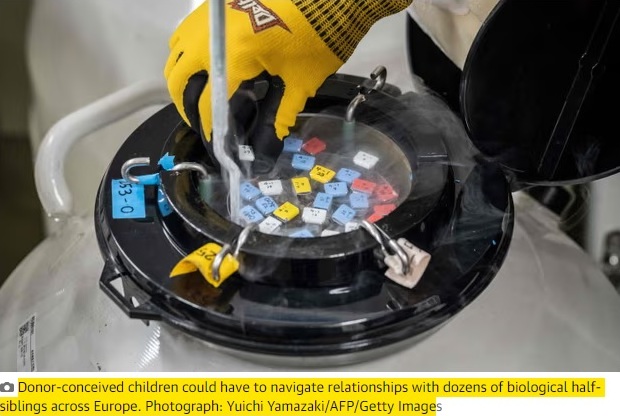
Experts have pointed out that the lifting of donor anonymity and the ability to track down genetic relatives on DNA testing sites are serious issues. These have led to the prospect of some donor-conceived children navigating relationships with dozens of biological half-siblings across Europe.
Concerned over the situation, experts have advised the Human Fertilisation and Embryology Authority (HFIA), an executive non-departmental public body of the Department of Health and Social Care in the UK, to tighten its restrictions! They told The Guardian that if the British citizens were allowed to donate sperm for a maximum of 10 families, then the same rule should also be applied to sperm export.
The Guardian quoted Chair of the Association for Reproductive and Clinical Scientists (ARCS) Professor Jackson Kirkman-Brown as saying: "If you believe that it is necessary to enforce the 10-family limit in the modern world then logically that should apply wherever the sperm are from." Professor Kirkman-Brown, who is also Director of the Centre for Human Reproductive Science at the University of Birmingham, added: "There is data showing that some of the children who find the really big families struggle with that."
For her part, Professor Lucy Frith of the University of Manchester, currently conducting research on donor-conceived experiences, stressed that making contact with biological half-siblings was often viewed positively. She told The Guardian: "But when numbers of siblings began to grow (it) felt unmanageable to have contact and relationships with a growing and indeterminate number of people." Professor Frith also said: "There are no hard and fast figures of when the number becomes 'too much' and this depends on individuals, but generally over 10 was felt to be a large group."
Read: 'You feel a bit mass-produced'
Five years ago, the UK was primarily an importer of sperm, mainly from Denmark and the US. However, the scenario has changed, with a growing number of international sperm and egg banks opening donor centres in the UK. In 2019-21, the UK exported 7,542 straws of sperm. As per data provided by the HFEA, one IVF cycle typically requires a single straw of sperm.
It may be noted that the European Sperm Bank, which accounts for 90% of exports, applies a worldwide limit of 75 families a donor, apart from estimating that its donors help 25 families on an average.
Boundless Ocean of Politics on Facebook
Boundless Ocean of Politics on Twitter
Boundless Ocean of Politics on Linkedin
Contact: kousdas@gmail.com





No comments:
Post a Comment